







Mostra i principali dati dell'item
| dc.contributor.author | Casas Hernández, Mariano | |
| dc.date.accessioned | 2026-01-08T08:00:13Z | |
| dc.date.available | 2026-01-08T08:00:13Z | |
| dc.date.issued | 2024 | |
| dc.identifier.citation | Casas Hernández, M.. (2024), Relecturas sobre las sibilas de la Capilla Dorada. En A. Rodríguez Laiz & I. Delgado Jara, Del Humanismo a las humanidades en el Renacimiento : alegorías y representaciones, textos y contextos (pp. 427-443). Peter Lang. | es_ES |
| dc.identifier.issn | 978-3-631-92304-7 | |
| dc.identifier.uri | http://hdl.handle.net/10366/168455 | |
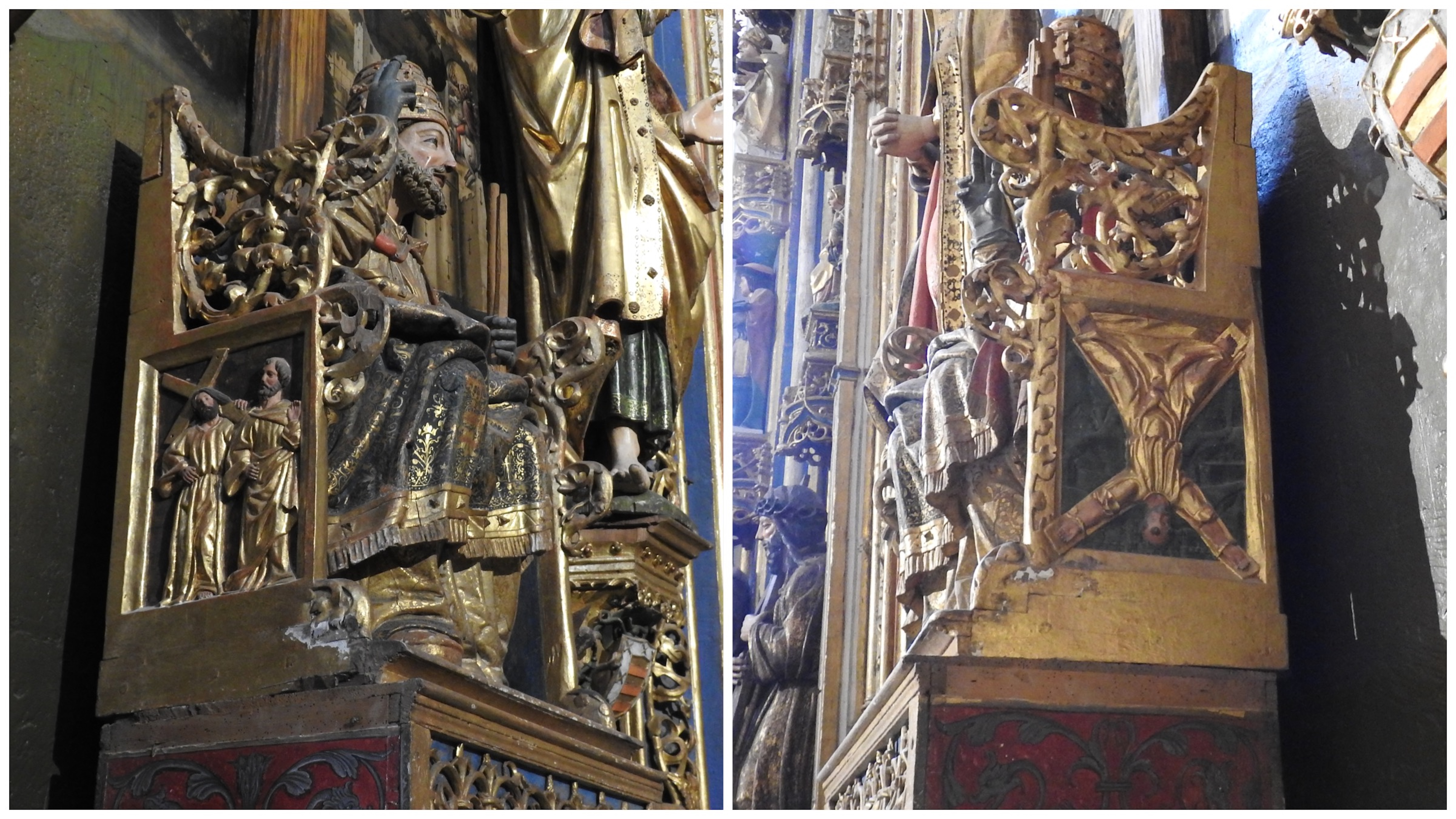
| dc.description | La Figura 1 muestra dos vistas de la cátedra de San Pedro en la Capilla Dorada de la Catedral de Salamanca, donde se pueden observar la escena del Quo vais y la del martirio. La Figura 3 recoge las fotografías de tres sibilas que conforman el programa de la Capilla Dorada de la Catedral de Salamanca. Entre ellas la sibila Dimeta. | es_ES |
| dc.description.abstract | [ES] Uno de los recintos más llamativos de la Catedral de Salamanca es la denominada Capilla Dorada. Sus muros, repletos de pétreas imágenes polícromas, han atraído la atención del público general y de los especialistas, coincidiendo estos en considerarlo como un ámbito singular donde se manifiesta el esplendor del tardogótico hispano con la recepción del primer renacimiento. Además, parece lugar común por parte de la historiografía que lo ha tratado, admitir la posibilidad de rastrear en el conjunto del ámbito sacro la progresiva recepción de las ideas del humanismo cristiano y del primer renacimiento en la sociedad del primer tercio del siglo XVI, una percepción que es preciso matizar a la luz de no pocas consideraciones. [ENG] One of the most striking areas of the Salamanca Cathedral is the Golden Chapel. Its walls, full of polychrome stone images, have attracted the attention of the general public and specialists, who agree in considering it as one of the unique places where the splendor of the Hispanic late Gothic is manifested with the reception of the first Renaissance. Furthermore, it seems commonplace on the part of the historiography that has dealt with it to admit the possibility of tracing in the entire sacred sphere the progressive reception of the ideas of Christian humanism and the first Renaissance in the society of the first third of the 16th century, a perception that must be qualified in light of many considerations. | es_ES |
| dc.language.iso | spa | es_ES |
| dc.publisher | Ana Rodríguez Laiz / Inmaculada Delgado Jara | es_ES |
| dc.rights | Attribution-NonCommercial-NoDerivatives 4.0 Internacional | * |
| dc.rights | Attribution-NonCommercial-NoDerivatives 4.0 Internacional | * |
| dc.rights.uri | http://creativecommons.org/licenses/by-nc-nd/4.0/ | * |
| dc.subject | Sibilas | es_ES |
| dc.subject | Humanismo | es_ES |
| dc.subject | Capilla Dorada | es_ES |
| dc.subject | Salamanca | es_ES |
| dc.subject | Palenzuela | es_ES |
| dc.subject | Sibyls | es_ES |
| dc.subject | Humanism | es_ES |
| dc.subject | Golden Chapel | es_ES |
| dc.subject | Catedral de Salamanca | es_ES |
| dc.title | Relecturas sobre las sibilas de la Capilla Dorada | es_ES |
| dc.title.alternative | Rereadings on the sibilas of the Golden Chapel | es_ES |
| dc.type | info:eu-repo/semantics/bookPart | es_ES |
| dc.subject.unesco | 5506.02 Historia del Arte | es_ES |
| dc.subject.unesco | 6203.09 Escultura | es_ES |
| dc.subject.unesco | 6203.05 Estética de las Bellas Artes | es_ES |
| dc.rights.accessRights | info:eu-repo/semantics/embargoedAccess | es_ES |
| dc.type.hasVersion | info:eu-repo/semantics/publishedVersion | es_ES |
Files in questo item


Questo item appare nelle seguenti collezioni

Excepto si se señala otra cosa, la licencia del ítem se describe como Attribution-NonCommercial-NoDerivatives 4.0 Internacional